By the 123Kids Editorial team · Last updated: November 15, 2026
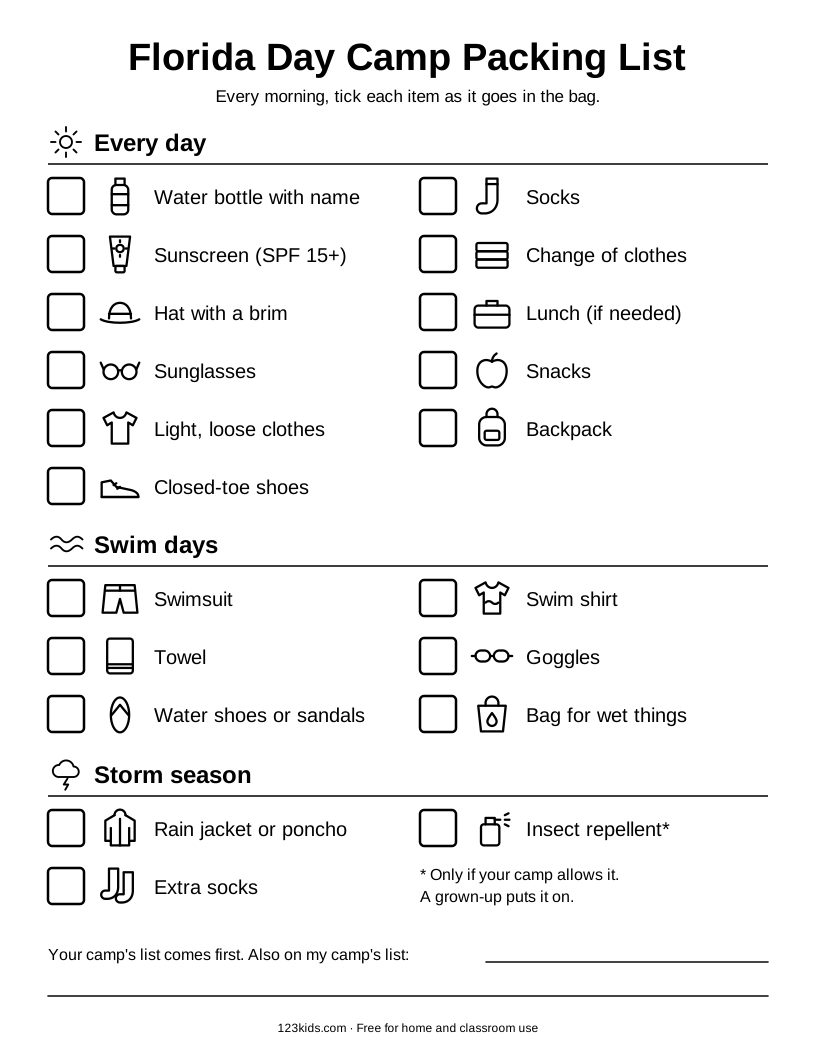
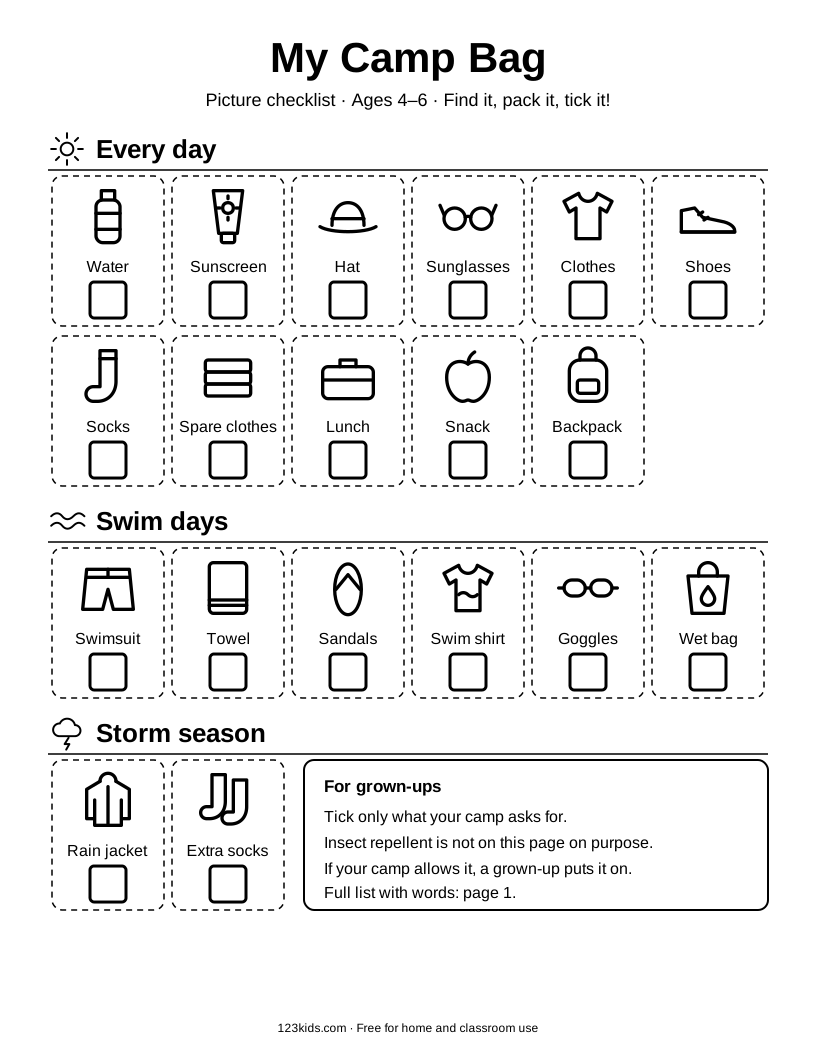
For a Florida day camp, pack a refillable water bottle with your child's name on it, sunscreen, a brimmed hat, a swimsuit and towel on swim days, a change of clothes, closed-toe shoes, a light rain jacket for afternoon storms, and lunch and snacks if the camp doesn't provide them. Our free two-page printable has all 20 items in one checklist, plus a picture version for ages 4–6, so your child can tick each one off in the morning. Your camp's own list always comes first.
Download the free 2-page packing list (PDF) · Free for home and classroom use
What should my child bring to day camp in Florida?
Pack for three situations: every camp day, swim days and stormy afternoons. Here is the full list from the printable.
| Every day | Swim days | Storm season |
|---|---|---|
| Water bottle with name | Swimsuit | Rain jacket or poncho |
| Sunscreen (SPF 15+) | Towel | Extra socks |
| Hat with a brim | Water shoes or sandals | Insect repellent, only if your camp allows it |
| Sunglasses | Swim shirt | |
| Light, loose clothes | Goggles | |
| Closed-toe shoes | Bag for wet things | |
| Socks | ||
| Change of clothes | ||
| Lunch (if the camp doesn't provide it) | ||
| Snacks | ||
| Backpack |
What's in the PDF:
| Page | What it is | Best for |
|---|---|---|
| 1. Packing checklist | All 20 items with large tick boxes and line drawings, plus a line to add items from your camp's list | Any age, with a grown-up reading along |
| 2. Picture checklist | The same items as big pictures with one or two words each (insect repellent left off, see below) | Ages 4–6 and early readers |
The artwork is original, black-and-white line art with no characters or brands.
How is packing for a Florida camp different?
Florida camp days mean strong sun, heat, afternoon thunderstorms and often a swim, so the list leans on sun gear, water, dry spares and a rain layer.
Sun and heat
- Sunscreen: the CDC recommends a broad-spectrum sunscreen with SPF 15 or higher, put on again after swimming, sweating or toweling off, and if your child is outside more than 2 hours. Ask your camp whether counselors help with reapplying and whether kids may carry their own bottle.
- Check the date: the same CDC page says sunscreen without an expiration date lasts no more than 3 years, and less if it has been exposed to high temperatures.
- Hat and sunglasses: CDC advises a hat with a brim all the way around to shade the face, ears and back of the neck, and sunglasses that block both UVA and UVB rays.
- Clothes and water: for hot weather, CDC suggests loose, lightweight, light-colored clothing and plenty of fluids, and avoiding really cold or very sugary drinks. A big refillable bottle makes that easier. Ask your camp where kids can refill it.
Afternoon thunderstorms
The Florida Department of Health notes that the state gets frequent afternoon thunderstorms, especially in summer. Pack a light rain layer and extra socks, and ask the camp about its lightning plan.
The National Weather Service rule is "When Thunder Roars, Go Indoors!" There is no safe place outside in a thunderstorm. Rain shelters and small sheds aren't safe; substantial buildings and hard-topped vehicles are. NWS advises waiting 30 minutes after the last lightning or thunder before going back outside, and having a lightning safety plan. NWS Miami adds that in Florida, more people are struck by lightning near or on water than anywhere else, which matters on pool and lake days.
Good questions for the camp:
- Where do the kids go when thunder is heard?
- How long do you wait before going back outside or into the pool?
- How will you tell parents if pickup or activities change because of weather?
Insect repellent, only if your camp allows it
Camps handle repellent differently, so ask first whether it's allowed and who puts it on. If it's allowed, follow the product label, which the EPA says to always read and follow. The EPA and CDC also say:
- Look for an EPA registration number ("EPA Reg. No.") on the label.
- Children shouldn't handle repellent. A grown-up puts it on their own hands first, then on the child.
- Don't apply it to a child's hands, eyes, mouth, cuts or irritated skin (CDC).
- CDC advises against products containing oil of lemon eucalyptus (OLE) or para-menthane-diol (PMD) for children under 3.
- If your child wears sunscreen too, CDC says to apply sunscreen first and repellent second.
- After camp, wash treated skin with soap and water (EPA).
That's why repellent is on the grown-up page but not on the picture page for young kids.
What should I leave at home?
Leave valuables at home, and check your camp's list for anything else it doesn't want brought in. Rules differ from camp to camp, so your camp's list is the one that counts. Things to ask about:
- Phones, tablets, smartwatches and games
- Toys, trading cards and anything that would be hard to lose
- Money
- Food with nuts or other common allergens (ask about the camp's allergy rules)
- Glass bottles or containers
- Medicine in your child's backpack (ask how the camp handles medicine instead)
What paperwork and health items does camp usually ask for?
It depends on the camp, so ask for its forms early. Questions worth asking before the first day:
- Which emergency contacts do you need, and who is allowed to pick up?
- Is there a form for medicine my child takes or carries?
- Do you need an allergy or health action plan, and from whom?
- Are any other health or permission forms needed (for example, for swimming or field trips)?
- What should I put on the lunch box and bottle labels?
Keep copies at home so you can fill in next year's forms faster. Our Florida summer camp registration dates guide can help you plan when to start.
How do I make the packing list work every morning?
Print it once, pack the night before, and let your child tick the boxes. A routine turns the list into a habit.
- Label everything. Bottle, lunch box, hat, towel and shoes. Matching swim gear and towels are easy to mix up.
- Pack the night before. Lay out the next day's clothes and fill the bag. In the morning, add the water and lunch.
- Check the camp calendar. Circle swim days and field-trip days on the printable so the right items go in.
- Hang it by the door. Slide the page into a plastic sleeve and tick with a dry-erase marker. You can reuse it all summer.
- Use the picture page for little ones. Kids ages 4–6 can point to each picture, find the item, then tick it. A grown-up checks the bag.
- Add your camp's extras. Page 1 has a line for anything special on your camp's list.
How should I print it?
Print on plain US Letter paper in black and white at "actual size" or 100%. Cardstock or a plastic sleeve helps it last all summer.
- Classrooms and camps: the checklist is free for home and classroom use.
- Privacy: the pages are filled in on paper. There's nothing to submit online, and nothing your child writes is collected or uploaded.
Still choosing a camp?
These guides help you pick a camp and plan when to register.
- How to choose a summer camp in Florida covers what to ask before you sign up.
- Florida summer camp registration dates shows when Florida cities and counties opened sign-ups in 2026.
- All 123Kids printables
This checklist is general packing guidance, not medical advice. Always follow your camp's own list and rules, and ask your pediatrician about your child's health needs. The printables are original artwork made by 123Kids, free for home and classroom use.
Preview the pages