Home › Printables › Florida Animals Coloring Pages
By the 123Kids Editorial team · Last updated: November 15, 2026
Download seven free pages: six Florida animal coloring pages and one matching page. The animals are the Florida manatee, loggerhead sea turtle, American alligator, Florida panther, gopher tortoise and American flamingo. Each page has thick outlines for small hands and one short, true fact at the bottom, checked against Florida wildlife agency sources. All the art is our own, and it prints in black and white on US Letter paper.
Download the Florida animals pack (PDF, 7 pages)
- Ages: 3–8 for the coloring pages; 5–8 for the matching page (it has words to read)
- Paper: US Letter, portrait, black and white
- Cost: free, no sign-up
Which Florida animals are in this pack?
The pack has six Florida animals, one per page, plus a "Which animal lives where?" matching page. Five animals in the pack are official Florida state symbols.
| Page | Animal | Fact printed on the page | Florida state symbol? |
|---|---|---|---|
| 1 | 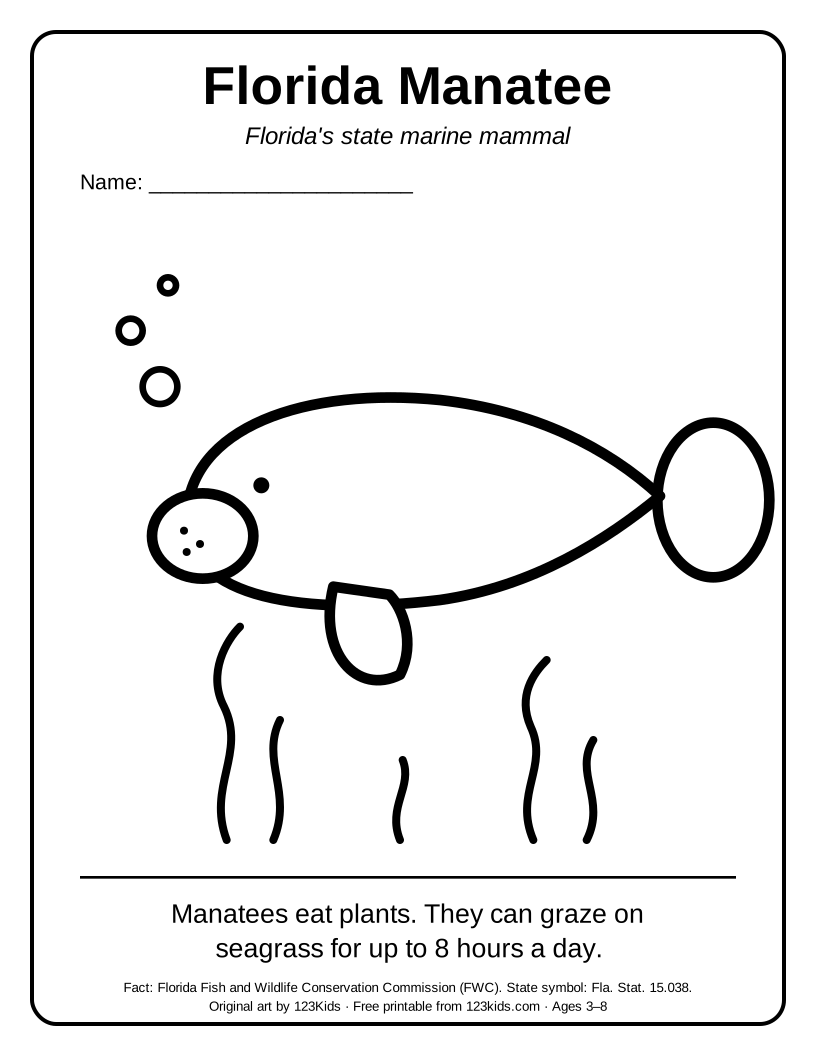 Florida manatee |
Manatees eat plants. They can graze on seagrass for up to 8 hours a day. | Yes, state marine mammal |
| 2 | 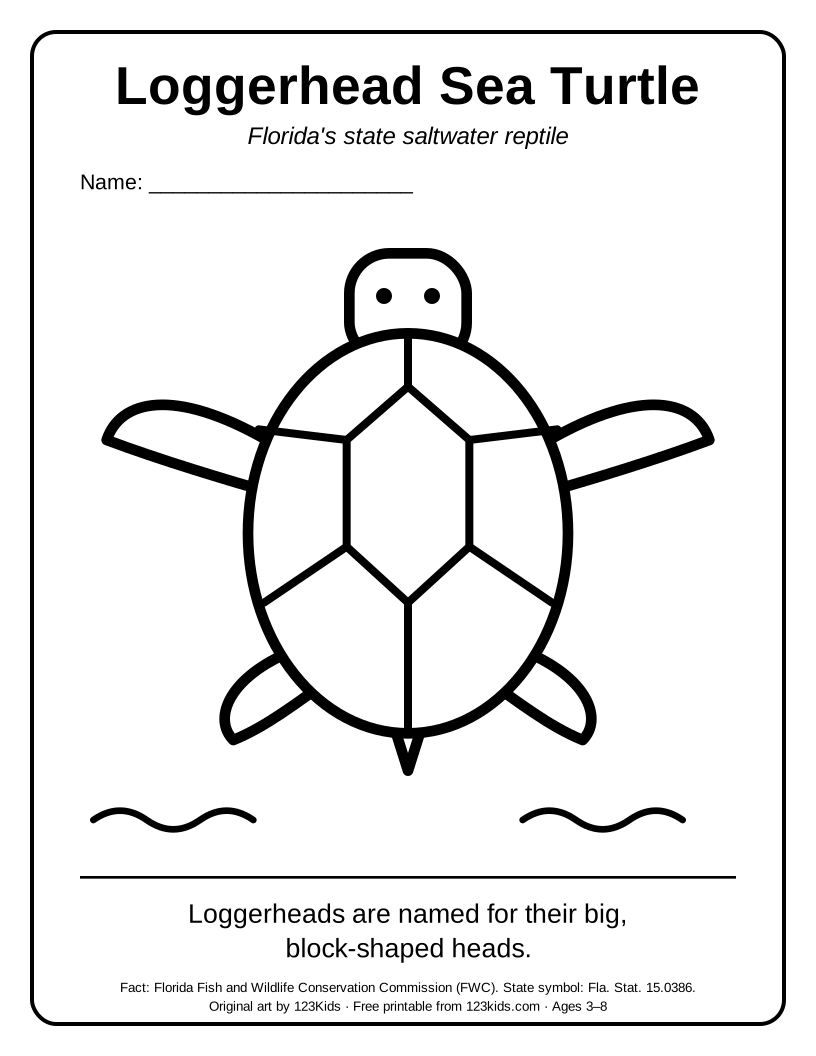 Loggerhead sea turtle |
Loggerheads are named for their big, block-shaped heads. | Yes, state saltwater reptile |
| 3 | 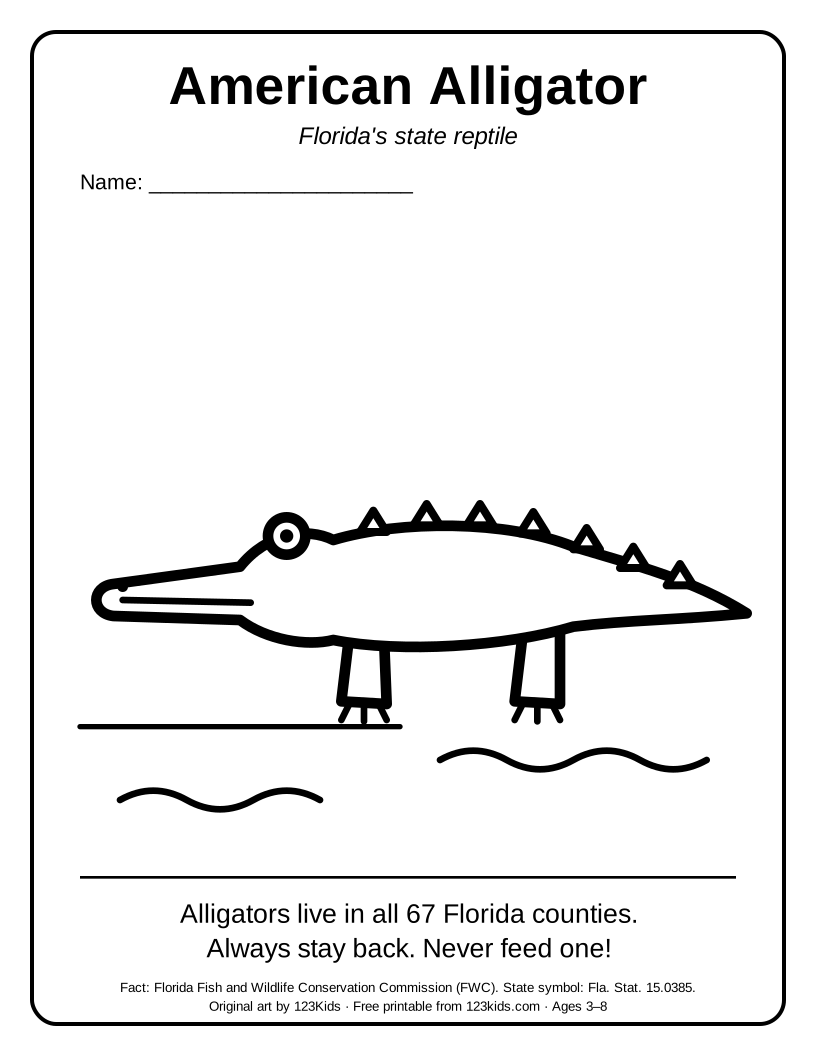 American alligator |
Alligators live in all 67 Florida counties. Always stay back. Never feed one! | Yes, state reptile |
| 4 | 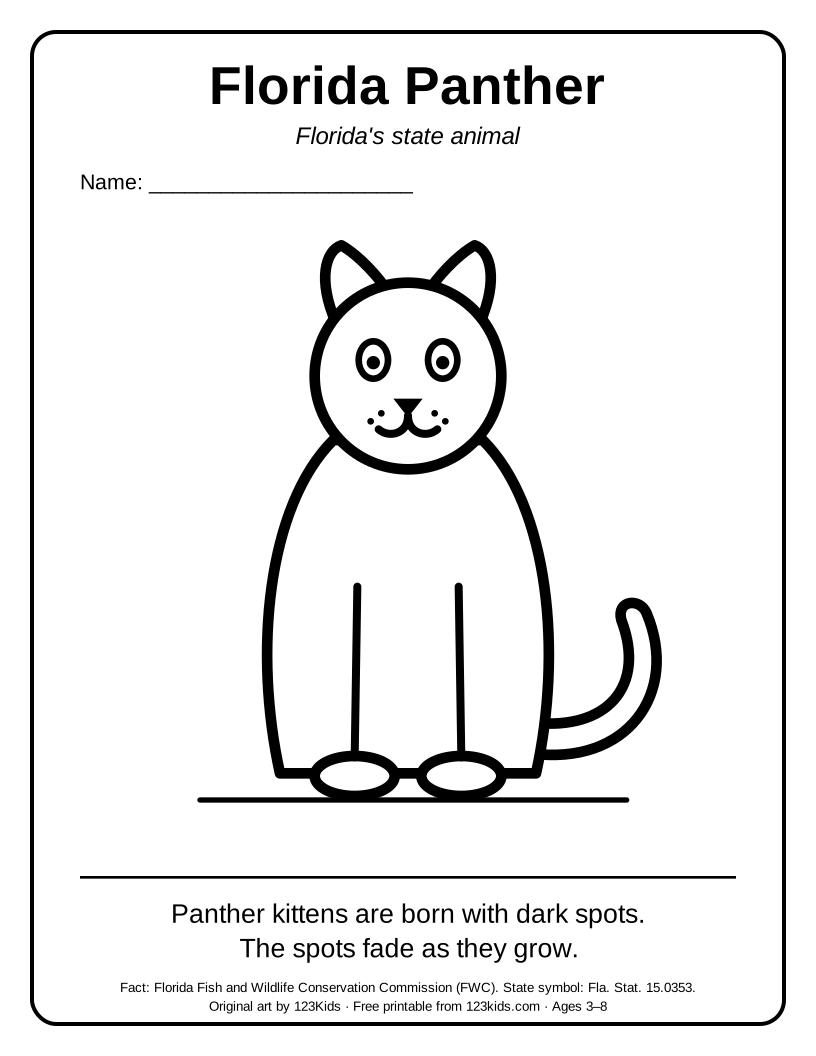 Florida panther |
Panther kittens are born with dark spots. The spots fade as they grow. | Yes, state animal |
| 5 | 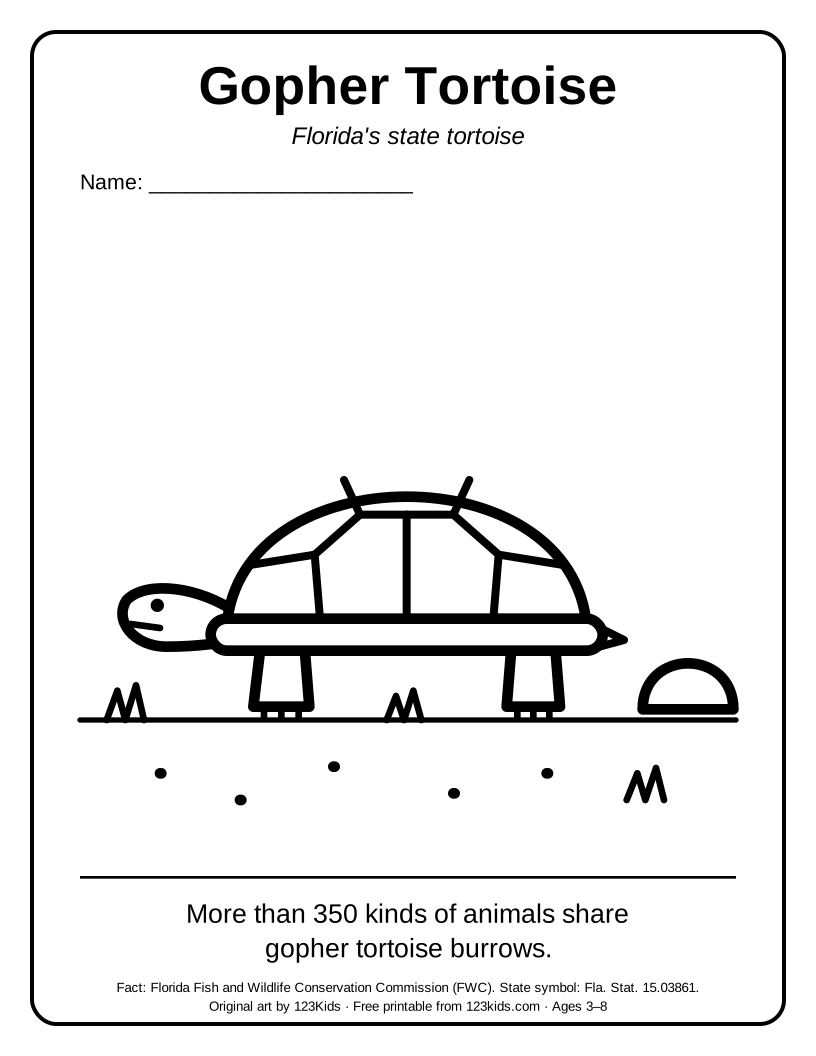 Gopher tortoise |
More than 350 kinds of animals share gopher tortoise burrows. | Yes, state tortoise |
| 6 | 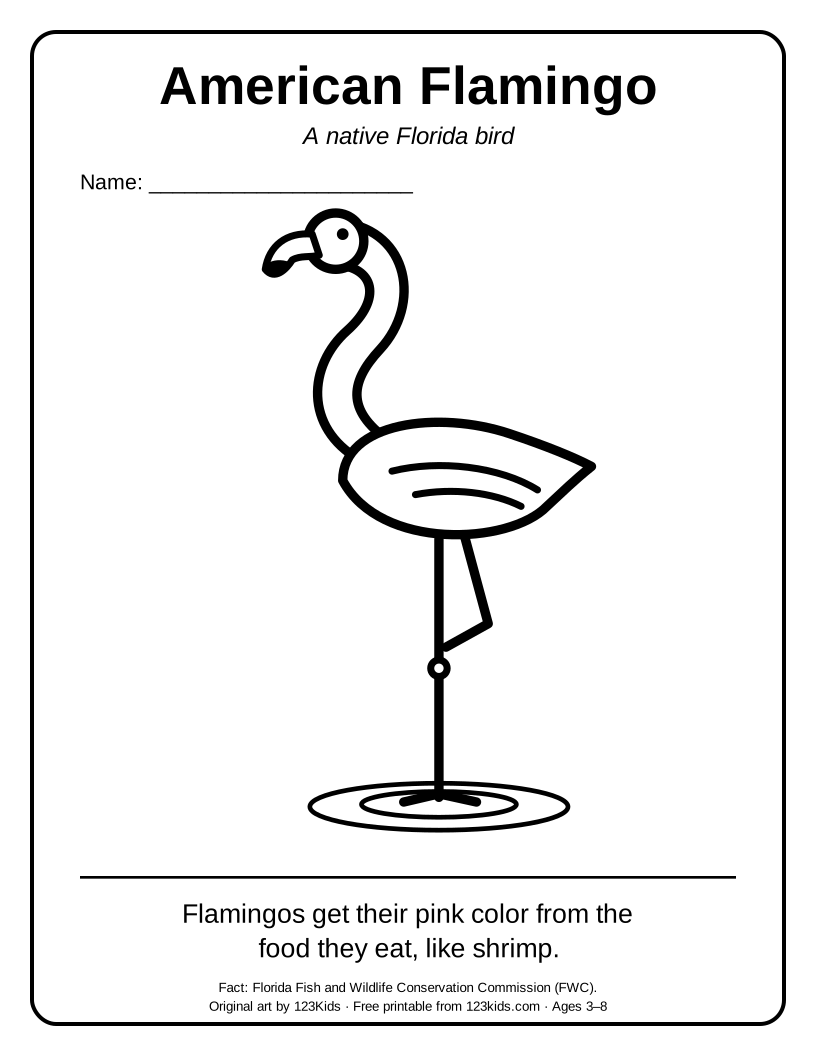 American flamingo |
Flamingos get their pink color from the food they eat, like shrimp. | Not one of the five listed below. FWC considers it native to Florida. |
| 7 | 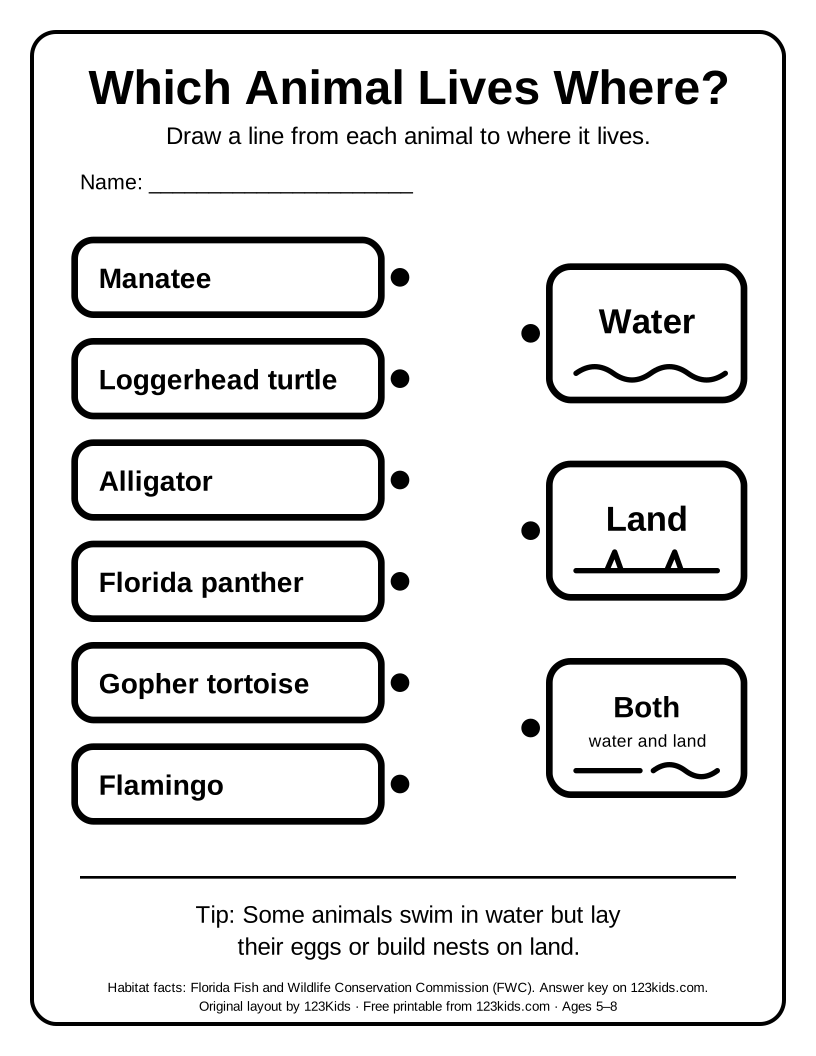 Matching page |
Draw a line from each animal to water, land, or both. | — |
The state-symbol column comes from Florida Statutes chapter 15: the Florida panther is the official state animal (s. 15.0353), the manatee is the state marine mammal (s. 15.038), the American alligator is the official state reptile (s. 15.0385), the loggerhead turtle is the official state saltwater reptile (s. 15.0386), and the gopher tortoise is the official state tortoise (s. 15.03861).
What are fun facts about Florida animals for kids?
Here is one kid-sized fact for each animal, plus a little extra for grown-ups who want to say more while kids color. Every fact comes from the Florida Fish and Wildlife Conservation Commission (FWC) or Florida State Parks.
What do manatees eat?
Manatees are plant-eaters. They graze on seagrass and other underwater plants, sometimes for as long as eight hours a day, according to FWC.
- Adults are usually 9 to 10 feet long and weigh around 1,000 pounds (FWC).
- The Florida manatee is a subspecies of the West Indian manatee. It lives in Florida's coastal waters, rivers and springs (FWC).
- Before the coldest winter months, manatees move to warm-water spots in Florida (FWC).
Why is it called a loggerhead sea turtle?
It is named for its huge, block-shaped head. The loggerhead is also Florida's most common sea turtle (FWC).
- Strong jaws let it crush and eat clams, crabs and other hard-shelled animals (FWC).
- An average adult weighs around 275 pounds, and its shell is roughly 3 feet long (FWC).
- Florida's Atlantic and Gulf beaches host one of the largest loggerhead nesting groups in the world. Nesting runs from April through September (FWC).
Where do alligators live in Florida?
Alligators are found in all 67 Florida counties. FWC estimated in 2024 that there were about 1.3 million alligators in the state (FWC, 2024).
- They like freshwater lakes, slow-moving rivers and nearby wetlands (FWC).
- Young alligators eat mostly insects, amphibians and small fish (FWC).
- Mother alligators build a mound nest out of soil and plants. An average nest holds 38 eggs (FWC).
What does a baby Florida panther look like?
Panther kittens are born with grayish-brown fur and dark spots. By about six months old, the spots are nearly gone (FWC).
- Adults are tawny brown, 5 to 7 feet long, and weigh 60 to 160 pounds (FWC).
- Panthers are most active at dawn and dusk, when the animals they hunt are active too (FWC).
- The Florida panther is protected as an endangered species under the federal Endangered Species Act (FWC).
Why are gopher tortoise burrows important?
Gopher tortoises dig deep burrows, and more than 350 other species share them. That is why FWC calls the gopher tortoise a keystone species (FWC).
- They eat low-growing plants (FWC). Florida State Parks lists favorites including grasses, prickly pear cactus and wild berries such as blackberries and blueberries (Florida State Parks).
- They live mainly in scrub and sandhill habitats (Florida State Parks).
- In Florida the gopher tortoise is listed as Threatened. The tortoise and its burrow are both protected by state law (FWC).
Why are flamingos pink?
Flamingos get their pink-to-red feathers from pigment in their food, including small water animals such as shrimp (FWC).
- The American flamingo is one of the largest flamingo species. It can stand up to 5 feet tall but weighs only about 4 to 8 pounds (FWC).
- FWC considers flamingos native to Florida and protects them under the federal Migratory Bird Treaty Act (FWC).
Where can kids see these animals safely in Florida?
The safest way to see wild Florida animals is from a distance, in public parks and refuges, without feeding or touching them. Manatees are often easy to spot in winter: they gather at warm springs, and several Florida state parks have viewing areas.
Where can we see manatees?
Blue Spring State Park in Orange City (FWC) is among Florida's biggest winter manatee spots. In the colder months, visitors can see hundreds of manatees in the park's 72-degree spring water from a boardwalk about a third of a mile long.
FWC's where to see manatees list also names these public state parks and national wildlife refuges:
| Place | Town or area | Type |
|---|---|---|
| Blue Spring State Park | Orange City | State park |
| Manatee Springs State Park | Chiefland | State park |
| Fanning Springs State Park | Fanning Springs | State park |
| Edward Ball Wakulla Springs State Park | Wakulla Springs | State park |
| Crystal River National Wildlife Refuge | Crystal River | National wildlife refuge |
| Merritt Island National Wildlife Refuge | Merritt Island | National wildlife refuge |
Check each park's page for hours, fees and current conditions before you go.
What are the wildlife safety rules for families?
Look, don't touch, and never feed. FWC sets out these rules for each animal in the pack:
| Animal | Rule for families | Source |
|---|---|---|
| Manatees | It is illegal to feed, harass or harm manatees. Don't grab, hold on to or ride them, don't disturb resting manatees, and never separate a mother from her calf. | FWC |
| All wildlife | Watch from a distance. Binoculars or a zoom lens give a closer look without getting close. | FWC |
| Sea turtles | Getting within 50 feet of a nesting turtle can make her give up nesting. Fill in holes you dig, take toys and chairs off the sand before sunset, and use lights only when needed at night. Disturbing nests or handling hatchlings is illegal. | FWC, 2026 |
| Alligators | Keep a safe distance. Never feed an alligator: it is illegal and dangerous. Swim only in designated areas during daylight, and keep leashed pets back from the shoreline. Alligators are most active from dusk to dawn. | FWC |
| Gopher tortoises | Leave wild tortoises alone. Moving or handling one can be illegal in Florida. An adult may help an uninjured tortoise across a road, in the direction it was heading, if it is safe to do so. | FWC |
Where do flamingos and panthers live?
Flamingos are mostly seen in far South Florida. Outside Hialeah, more than 95% of Florida flamingo sightings have been in the Everglades, Biscayne Bay and the Florida Keys (FWC). Florida panthers live in peninsular Florida, mainly south of Orlando (FWC). They are endangered wild cats, so these pages are a good way to "meet" one.
How can teachers and parents use these pages?
Use them as a calm coloring break, a conversation starter about Florida wildlife, or a lead-in to a nature walk. A few ideas:
- Read the fact aloud first. Then ask one question, such as "What do you think a manatee eats?" before kids color.
- Sort by habitat. After coloring, kids sort the six pages into water, land, or both. Then try the matching page.
- Make a class book. Staple the seven pages together with a cover the kids design.
- Talk about state symbols. Five animals in the pack are official Florida state symbols, and each of those pages says so under the title. Kids can circle them.
- Practice the safety rules. Pair the alligator and manatee pages with the "look, don't touch, never feed" rules above before a trip to a park.
These are activity ideas, not a lesson plan. We have not mapped them to any curriculum or standard.
What is the answer key for the matching page?
Some animals fit more than one answer, so accept any answer a child can explain.
| Animal | Answer | Why (FWC) |
|---|---|---|
| Manatee | Water | Lives in coastal waters, rivers and springs (FWC) |
| Loggerhead turtle | Both | Lives in the sea and nests on sandy beaches (FWC) |
| Alligator | Both | Lives in lakes, rivers and wetlands; builds nests from soil and plants (FWC) |
| Florida panther | Land | A land mammal of peninsular Florida (FWC) |
| Gopher tortoise | Land | Digs burrows and eats low-growing plants (FWC) |
| Flamingo | Both (water is fine too) | Has webbed feet for wading in shallow water (FWC) |
How do I print the pages?
Print at actual size (100%) on US Letter paper, portrait, in black and white. If your printer adds margins, choose "Fit to page." Crayons and washable markers both work on the thick outlines. For younger kids, print one page at a time so the choice isn't overwhelming.
More Florida printables
- Florida winter break activity pack: screen-free pages for the school break.
- All 123Kids printables: more free pages for parents and teachers.
Download the Florida animals pack (PDF, 7 pages)
About this pack: the drawings are original line art made by the 123Kids team. Facts were checked against the Florida Fish and Wildlife Conservation Commission, Florida State Parks and the Florida Statutes on November 9, 2026. 123Kids is written for parents and teachers.