By the 123Kids Editorial team · Last updated: November 15, 2026
This free pack has three printable pages made for a Florida winter break: a screen-free bingo card for warm-weather days, a two-week break planner, and an outdoor nature scavenger hunt. The pages are for kids ages 4 to 10, and none of them needs snow. Print them at home in black and white and let kids check things off all break.
Download the free 3-page pack (PDF) · Free for home and classroom use
What's in the winter break activity pack?
You get three US Letter pages, all in black and white, for ages 4 to 10:
| Page | What it is | Best for |
|---|---|---|
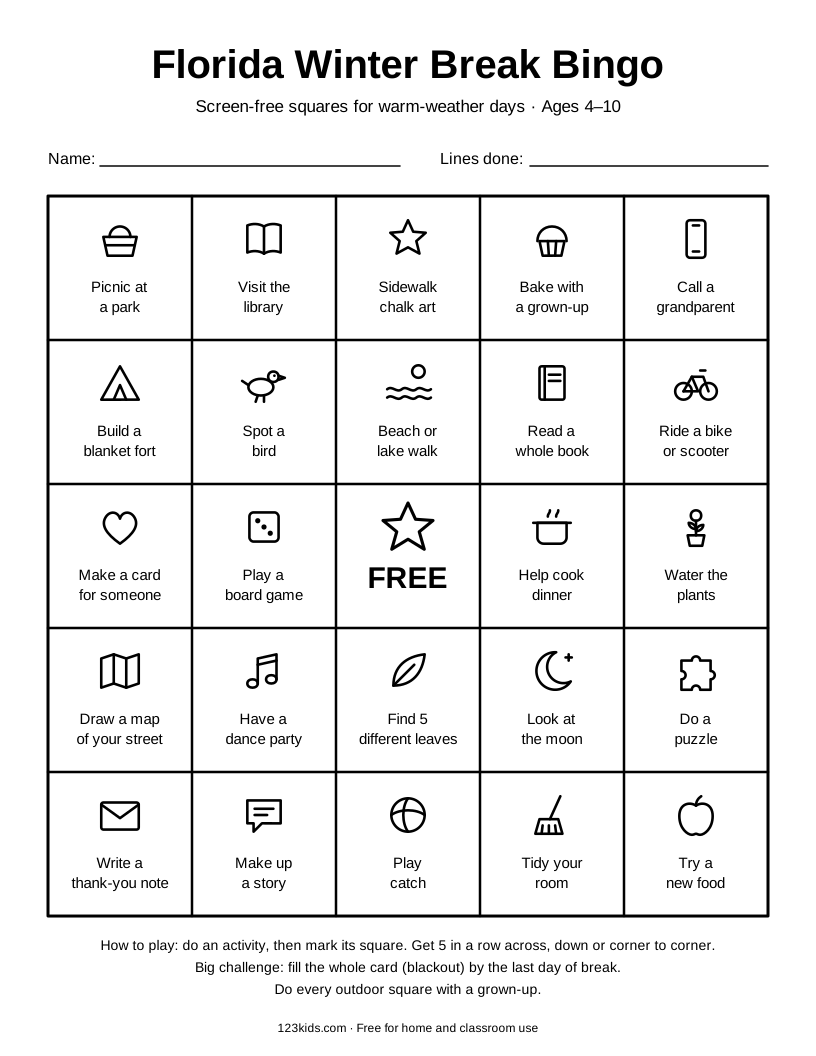
| 1. Winter break bingo | A 5×5 card with 24 screen-free activities and a FREE center square | The whole break; ages 4–10 |
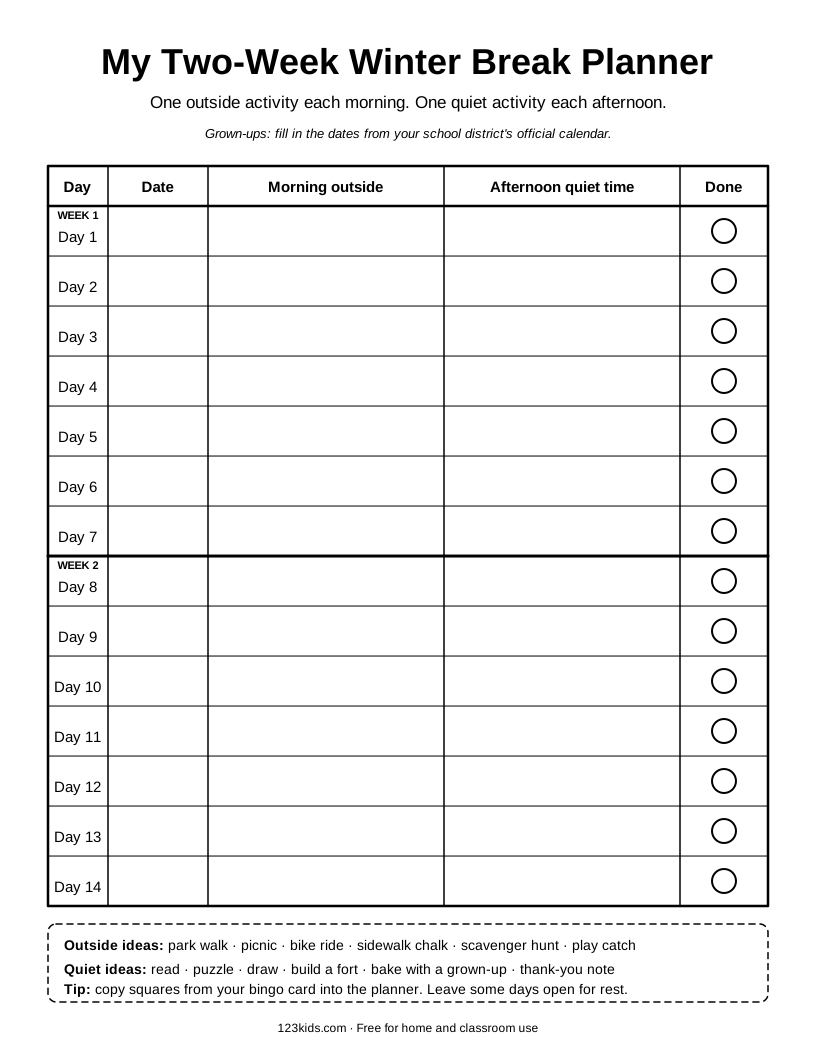
| 2. Two-week planner | 14 rows, each with a blank date, one morning outside activity and one afternoon quiet activity | Parents planning ahead; older kids can fill it in |
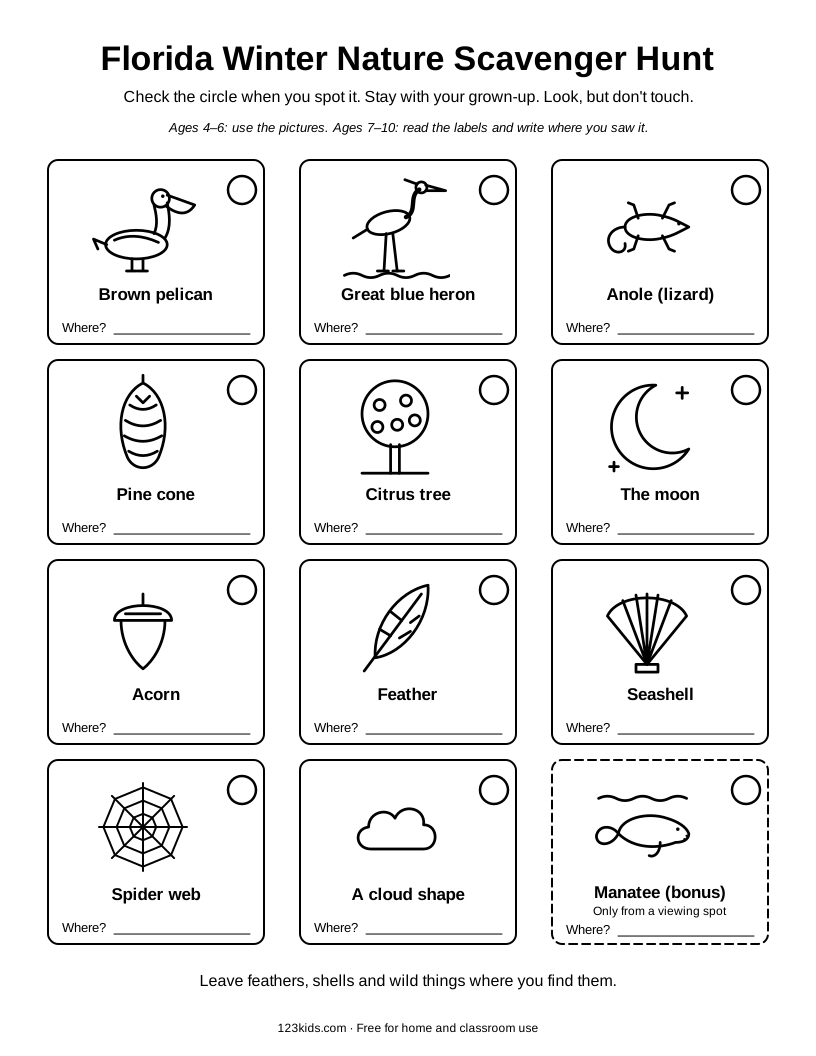
| 3. Nature scavenger hunt | 12 picture boxes with check circles, from pelicans to pine cones | Park, beach, lake or backyard walks |
Every activity is original. There are no characters, brands or paid attractions, so any family can do every square with what's around them.
How do you play winter break bingo?
Do an activity, then mark its square. Five in a row wins (across, down or corner to corner). For a bigger challenge, try for a blackout, which means filling the whole card by the last day of break.
The squares are things Florida kids can actually do in December, with no snow or sledding required:
- Outside: picnic at a park, sidewalk chalk art, beach or lake walk, ride a bike or scooter, play catch, spot a bird, find 5 different leaves, look at the moon, water the plants
- Inside: build a blanket fort, read a whole book, play a board game, do a puzzle, have a dance party, make up a story, tidy your room
- With family: bake with a grown-up, help cook dinner, call a grandparent, try a new food
- Kind and creative: visit the library, make a card for someone, write a thank-you note, draw a map of your street
Tips that keep it fun: - Let younger kids (4–6) go by the pictures. A grown-up can read the labels. - Agree on a small reward for a line and a bigger one for a blackout, like picking the next family movie night or the picnic spot. - Grown-ups should come along for every outdoor square, especially the beach or lake walk.
How do I plan a two-week break without screens all day?
Give each day one anchor: something outside in the morning and something quiet in the afternoon. Everything else can stay loose. The planner page has 14 rows for exactly that, with blank date boxes so it works whatever your schedule.
- Fill in the dates first. Each Florida school district sets its own break dates, so take them from your district's official school calendar.
- Pick the morning outside activity. Getting outside early leaves the afternoon free for quieter play. Good choices are a park walk, a bike ride, chalk art or the scavenger hunt.
- Pick the afternoon quiet activity. Try reading, a puzzle, drawing, baking with a grown-up or building a fort.
- Copy bingo squares into the planner. Then the bingo card and the planner work together.
- Leave a few days blank for travel, visitors or doing nothing at all.
Sun protection still matters in winter. The CDC says UV rays still reach you on cloudy and cool days. It recommends protecting skin all year, not just in summer with shade, a brimmed hat, sunglasses that block UVA and UVB, and broad-spectrum sunscreen of SPF 15 or higher. Reapply after 2 hours in the sun, and after swimming or sweating.
What can kids spot outside in a Florida winter?
Plenty. The scavenger hunt page has 12 things to look for at a park, beach, lake or in your own yard. Some are animals and plants, and some are everyday finds like a feather, a spider web or a funny-shaped cloud. Ages 4–6 use the pictures. Ages 7–10 read the labels and write down where they spotted each one.
Here is what to know about the wildlife on the page:
| On the hunt | What to look for | Source |
|---|---|---|
| Brown pelican | A big bird up to 48 inches long that dives headfirst into the water for fish. FWC says brown pelicans are widespread along the Florida coast and can be seen inland during the non-breeding season. Look on beaches, sandbars and docks. | FWC |
| Anole (lizard) | The green anole is the only anole native to the United States. It can change from bright green to brown in seconds, and males show a red throat pouch. Green anoles usually live in trees. The brown anole was introduced from the Caribbean and is usually on the ground or on low plants. | NPS |
| Manatee (bonus) | When the water falls below 68°F, manatees gather at springs, power plant outflows and other warm-water sites. See the viewing rules below. | FWC |
The hunt also includes a great blue heron, a pine cone, a citrus tree, an acorn, a seashell and the moon. These are picture-only items with no species claims, so kids can count any one they find.
Bonus birds for keen spotters: An Audubon Florida article (Feb 2025) reports a staff member seeing a large flock of American robins and cedar waxwings in her backyard north of Orlando in winter, and notes they are not permanent residents.
How should kids watch manatees?
From a distance, and quietly. FWC's manatee viewing guidelines put it simply: look, but don't touch. Before you go, run through these with your kids:
- Keep your distance and just watch.
- Never feed manatees or give them water. FWC says manatees that get used to people can lose their fear of boats and humans, which puts them at more risk.
- Don't chase or follow a manatee that swims away.
- Keep noise and splashing down near resting manatees, and never separate a mother from her calf.
- Stay out of areas marked "No Entry – Manatee Refuge."
FWC asks everyone to give manatees plenty of space and never harass, feed or disturb them. Its November 2, 2026 release also warns that disturbing them at warm-water sites can push them into cold water, which can be life-threatening. If you see an injured, sick or dead manatee, don't touch it. Report it to the FWC Wildlife Alert Hotline at 888-404-FWCC (3922).
The hunt has a few more rules on the page: stay with your grown-up, look but don't touch, and leave feathers, shells and wild things where you find them.
Where can I take kids for free or cheap over winter break?
Start with public places: the public library, city and county parks, and local nature centers. Look on your library's and parks department's own websites for holiday programs, and check the dates, times and whether you need to register.
- Public library: story times, craft sessions and reading challenges. A library visit is also a bingo square.
- City and county parks: playgrounds, picnic areas, trails and lake or beach access. These are great for the scavenger hunt.
- Nature centers and preserves: often the best places to spot birds and anoles. Fees vary, so check the official site before you go.
- State parks: a good day out for the scavenger hunt. Check the park's official page for entry fees and hours.
Always confirm opening days with the venue before you head out, because hours can change around the holidays.
How should I print the pack?
Print on plain US Letter paper in black and white, at "actual size" or 100% scale. The pages are line drawings with very little ink, so a home printer works fine.
- Bingo card: cardstock lasts all break. Kids can mark squares with a crayon, stickers or a stamp.
- Planner: stick it on the fridge so everyone can see the day's anchor.
- Scavenger hunt: clip it to a clipboard (or a piece of cardboard with a binder clip) and bring a pencil. Print one per child so nobody has to share the check circles.
- Classrooms: the pack is free for home and classroom use. Teachers can send it home before break as an optional activity.
More free printables
- Florida animals coloring pages has Florida wildlife to color.
-
New year goals for kids is a simple goal sheet for the end of break.
Wildlife facts come from the Florida Fish and Wildlife Conservation Commission, the National Park Service and Audubon. Sun-safety guidance comes from the CDC. All were checked on November 9, 2026. 123Kids is not affiliated with these organizations. The printables are original artwork, free for home and classroom use.
Preview the pages